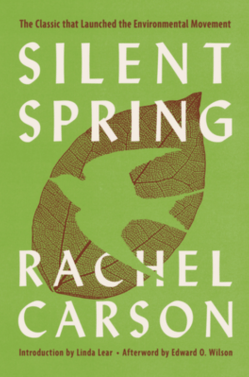
Silent Spring

Rachel Carson | 1962

This sensational book, Silent Spring (1962) by Rachel Carson, warned of the dangers to all natural systems from the misuse of chemical pesticides such as DDT, and questioned the scope and direction of modern science, initiating the contemporary environmental movement.

Silent Spring began with a “fable for tomorrow” – a true story using a composite of examples drawn from many real communities where the use of DDT had caused damage to wildlife, birds, bees, agricultural animals, domestic pets, and even humans. Carson used it as an introduction to a very scientifically complicated and already controversial subject. This “fable” made an indelible impression on readers and was used by critics to charge that Carson was a fiction writer and not a scientist.


Silent Spring, the winner of 8 awards*, is the history-making bestseller that stunned the world with its terrifying revelation about our contaminated planet. No science-fiction nightmare can equal the power of this authentic and chilling portrait of the unseen destroyers which have already begun to change the shape of life as we know it.

“Silent Spring is a devastating attack on human carelessness, greed and irresponsibility. It should be read by every American who does not want it to be the epitaph of a world not very far beyond us in time.” – Saturday Review

*Awards received by Rachel Carson for this book:

        • The Schweitzer Medal (Animal Welfare Institute)
        • The Constance Lindsay Skinner Achievement Award for merit in the realm of books (Women’s National Book Association)
        • Award for Distinguished Service (New England Outdoor Writers Association)
        • Conservation Award for 1962 (Rod and Gun Editors of Metropolitan Manhattan)
        • Conservationist of the Year (National Wildlife Federation)
        • 1963 Achievement Award (Albert Einstein College of Medicine — Women’s Division)
        • Annual Founders Award (Isaak Walton League)
        • Citation (International and U.S. Councils of Women)

President Jimmy Carter posthumously awarded Carson the Presidential Medal of Freedom.


‘Silent Spring’ inspired the modern environmental movement, which began in earnest a decade later. It is recognized as the environmental text that “changed the world.”

Serialised in three parts in The New Yorker, where President John F. Kennedy read it in the summer of 1962, Silent Spring was published in August and became an instant best-seller and the most talked about book in decades. Utilising her many sources in federal science and private research, Carson spent over six years documenting her analysis that humans were misusing powerful, persistent chemical pesticides before knowing the full extent of their potential harm to the whole biota. Read more

Bibliography

Carson, R. (1962) Silent Spring. Boston, Massachusetts, United States: Houghton Mifflin.

Carson, R. (2002) Silent Spring: The classic that launched the environmental movement [anniversary edition]. Boston, Massachusetts, United States: Houghton Mifflin Company.

Quotes from Silent Spring (source: Goodreads).

Read also The Story Behind ‘Silent Spring’.

Creating Public Value

Strategic management in government

Mark H. Moore | 1995

Public Value is a theory for public management advanced by Professor Mark Moore of the Harvard Kennedy School. Over the previous two decades, staff and students at Harvard’s Kennedy School of Government, where Moore taught, engaged in conversations about producing excellence in public management.

“Public value refers to the value created by the government through laws, regulations, services and any other action. In a democratic society, this value is defined by the public themselves. Value is determined by citizens preferences expressed in a variety of ways and thus it provides a rough yard stick against which to gauge the public institutions and government policies.”

A seminal figure in the field of public management, Mark Moore presents his summation of fifteen years of research, observation, and teaching about what public sector executives should do to improve the performance of public enterprises.

This book is useful for both practising public executives and those who teach them. It explicates some of the richest of several hundred cases used at Harvard’s Kennedy School of Government and illuminates their broader lessons for government managers.

Moore addresses four questions that have long bedevilled public administration: What should citizens and their representatives expect and demand from public executives? What sources can public managers consult to learn what is valuable for them to produce? How should public managers cope with inconsistent and fickle political mandates? How can public managers find room to innovate?

Moore’s answers respond to the well-understood difficulties of managing public enterprises in modern society by recommending specific, concrete changes in the practices of individual public managers: how they envision what is valuable to produce, how they engage their political overseers, and how they deliver services and fulfil obligations to clients.

Following Moore’s cases, we witness dilemmas faced by a cross-section of public managers from the Environmental Protection Agency, the Department of Youth Services, the Park Plaza Redevelopment Project, the swine flu scare, the Houston Police Department, and the Boston Housing Authority. Their work and Moore’s analysis reveal how public managers can achieve their true goal of producing public value.

Bibliography

Moore, M. (1995) Creating Public Value: Strategic management in government. Cambridge, Massachusetts, United States: Harvard University Press.

Read Chapter 3 (source Harvard University Education).

Is the end of risk management near?

A collective reconsideration

Marinus de Pooter | 2015

For those who listen in various sectors, the picture quickly emerges that risk management is not successful in practice. And that despite all the investments made and the energy that has been put into it in recent years. If risk management does indeed bring so much good (as is usually claimed), how is it possible that line managers do not flock to training and conferences? Why don’t they queue up to learn more about all those wonderful concepts and tools (including the many impressive software applications)? As a management system, has it sold so badly or can it simply not deliver what is promised? Perhaps it is a combination of both. It’s time for something better. As far as I am concerned, the end of conventional risk management is near. I refer to the instrumental approach from a separate staff function. The limited enthusiasm for this usual setup is due to several factors. I will mention a number of observations from the consultancy practice.

Usually, risk management is invested in a separate function or in different specialised functions such as Security, Quality and Safety, et cetera. This easily leads to responses from line managers along the lines of: “We hired you to take care of those (information security) risks!” Regulators have devised the creation of a separate Risk Management department (or even a separate CRO function) as a counterbalance to the overthrown ambitions of line managers. However, just because of the differences in personalities, its effectiveness can only be limited. If you do something about risk management, because your supervisor requires it or because the head office requires it from you, it will not easily be embedded in your day-to-day operations. If you use it as an accountability tool, it will at most help to give supervisors a sense of (false) security.

As the backbone of their risk management systems, many organisations have built extensive management frameworks, for example for their financial reporting, information security, business continuity, etc. These frameworks, whether or not coordinated with each other, fit perfectly into a planning & control way of thinking. However, the unruly reality appears to only want to adapt to these frameworks moderately. Not least because of important disruptive factors such as people of flesh and blood. The “control frameworks” fit within the philosophy that the world can be made. If your goals are clear, you estimate your risks properly, you design, implement and implement appropriate measures, then you have reasonable assurance that reality will unfold as you did at the ‘P’ of your PDCA cycle (Plan-Do-Check-Act). In practice, this is considerably more nuanced.

The future is immensely complex, making simple predictions illusions. Some operational cause-effect relationships in a conditioned environment may be evident, but others (especially strategic ones) are difficult to determine. Many approaches conveniently ignore the limitations of our human capacities, such as estimating probabilities. If you imagine the world as an endless chain of causes and effects, then it is impossible to get a full picture of the future variants (scenarios). However, this relativity often remains unexplained, such as when determining resistive capacities.

It is also difficult that opportunities and risks are not tangible or identifiable. They are conceptual representations of future events or circumstances, which can be different for everyone. This realisation is suppressed in the more instrumental approach to risk management. Common tools such as risk registers and risk profiles can be very misleading. For example, they provide little insight into the mutual dependencies of the risk categories and the extent to which the organisational objectives will be achieved according to expectations. Moreover, the (dark red) top corner in risk diagrams (the well-known ‘heat maps’) is unrealistic: no organisation goes bankrupt (high probability) on a daily basis (high impact).

Structured thinking about the future is negatively used in conventional risk management. If you only focus on things that can go wrong, you are not holistic about the future. If you use separate risk reports with “key risk indicators”, then you give the signal that controlling threats (risk management) is separate from exploiting opportunities (performance management). You miss the connection with most directors and managers if you look at risks in isolation from opportunities. In the real world, they always go hand in hand: if you want to rule out personnel fraud completely, then as a manager you have to do everything yourself (and of course be honest as an employee).

When things go wrong, the media eagerly responds to sensational incidents. Don’t we think it’s all spectacular when a few large cranes fall on houses in Alphen aan den Rijn? However, thinking in a structured way about possible errors in advance turns out to be much less popular, because it is quickly associated with failure. For example, in an environment dominated by engineers, confidence in one’s own (technical) capabilities is nurtured. Even if the management team is primarily action-oriented, the structured improvement of the internal organisation can become subordinate to the “real work”. Not enough time is taken for reflection. The hustle and bustle of everyday life, such as putting out all kinds of fires, then determines the agenda.

Functional compartmentalisation quickly develops, especially in larger organisations. This makes it difficult for the management of the organisation to obtain and maintain a total overview of the operational management. The directing function is often less developed. And this while integrated opportunity and risk management is one major coordination issue to focus the separate disciplines and areas of knowledge on jointly achieving the formulated organisational objectives.

The above observations do not lead to great joy. It is therefore time for a rethink. Our brainpower and resources can be better spent. In my opinion, answering the main question for each management team should be central: do we manage our organisation in such a way that we meet the expectations of our most important stakeholders?

Suggestions

Below I give a number of point-by-point suggestions on how to achieve this in practice. In essence, they boil down to the removal of separate risk management functions. The focus should be on training decision-makers to make balanced decisions based on the agreed core values ​​and the best available information. This requires intensive cooperation and a heavy directing role for the management of the organisation.

    1. With a holistic approach you always look at opportunities and risks together. A project manager is alert to future circumstances that could promote (opportunities) or hinder (risks) the realisation of his or her objectives. It is about the integral performance that you achieve as an organisation. In that context, we should no longer use ‘risk management’ as an umbrella term. After all, most people associate that designation with things you shouldn’t have. Therefore, just use terms such as ‘(integral) management’ or ‘organise’.
    2. Many successful large SMEs do not have a separate risk management function. Of course, those management teams do manage their risks, although perhaps less explicitly than in conventional risk management. Transfer the compartmentalised risk management activities to other departments, such as Strategy & policy, Planning & control, Information provision, et cetera, and at P&O for training skills. Make sure that there is a coordination function high up in the organisation for the essential directing role.
    3. What makes integral opportunity and risk management especially challenging is that it is about the future. And that is simply uncertain. For example, no one knows whether Bitcoin will be the currency of the future or the next bubble. Realise that, as a team or individual, you can at most make the best possible move, making use of the available information.
    4. Probability and risk management is actually ‘expectation management’. Avoid unrealistic expectations. As humans, we are simply subject to many limitations. Consider the quality (timeliness, correctness, completeness, etc.) of our available information and the limitations of our human mind to make effective estimates. Be sure to also be alert to the temptations that can cause people to make wrong choices.
    5. In an environment steeped in planning and control, vigorous leadership is welcomed. “Yes, we can!” is associated with piloting the organisation’s ship through the turbulent waves. However, you must admit that you do not know exactly how it will all turn out. It is not that strange when the future is by definition uncertain.
    6. Management is about making decisions to create and maintain the intended value for your important stakeholders. The real added value of integrated management of opportunities and risks lies in the contribution to that decision-making. You need good information for good decision-making. Therefore, fully commit to knowledge management and big data, which will play an increasingly important role.
    7. Opportunity and risk management focuses on realizing the explicit and implicit objectives. The interests of specific stakeholders are decisive for these objectives. There are always interests involved when making decisions. See through that game. If you don’t understand what interests are in the background, you can never perform effective analyses of opportunities and threats.
    8. When you talk about creating and protecting value, the first question is of course what you understand by ‘value’. All too often it turns out to be about euros or dollars. But is money the end or the means? The answer depends on what your key stakeholders expect from your organisation. As a management team, first discuss what you really value. Only then does it make sense to talk about opportunities and risks.
    9. When organizing your (civil service) company to deliver and retain value for your important stakeholders, your vision is guiding. It must be clear to every employee in the organisation what you want to achieve together. That includes being clear about what you don’t want to achieve. Then the discussion automatically arises, which again was the intention of the organisation. Invest in developing and propagating that clear vision.
    10. Thinking together about opportunities and risks can best be done with daily activities as the basis. Your colleagues have to make their decisions there. Whether it concerns management, primary or supporting processes. They can make mistakes when carrying out any of the activities. They must also seize the opportunities there. Provide an integrated overview of what the important players within your organisation are doing. Without this overview it is difficult to see the interrelationships and to prioritize the desired improvements.
    11. Integrated opportunity and risk management is always about options for human action. Then you cannot avoid talking about ethics. If you reason from a “the-end-justifies-the-means” principle, you may be able to get away with inadequate legislation or enforcement. However, remember that there is more that you should not do beyond what is explicitly prohibited.
    12. In order to be able to make good judgments, you need clear core values ​​in addition to sound information. For example, to judge an investment that pays off nicely, but is ethically questionable. Core values ​​determine which stakeholders (and their interests) are dominant, what weighs most heavily in thorny issues and what behavior is expected of employees. They also play a key role in operationalising the tricky concept of ‘risk appetite’ (and its counterpart ‘chance greed’). Make sure your core values ​​are clear to all involved.
    13. The attitude of the people you have on board is decisive for a successful internal organisation. The CEO of a major international real estate investor recently told me that his chief risk manager is the Human Resources Director. Analyze the risk attitude of your managers. Select strictly at the gate on the moral compass and mentality of possible new colleagues. Also, as soon as possible, put people outside the gate who do not fit the intended core values ​​of your organisation.
    14. The owners of the objectives (and therefore of the processes required to achieve those objectives) must constantly make trade-offs. Namely what value they want to create and protect for which stakeholders. Make sure they have the necessary specialist help in realizing their objectives, for example because legislation and regulations (such as collective labor agreements) are complex, because technologies change quickly, et cetera.
    15. The added value of risk managers, controllers, compliance officers and similar functions lies in supporting those who serve the customers (citizens, tenants, patients, students, etc.). Require all staff positions to be of service to their colleagues who serve customers in the primary processes. They always have to make difficult decisions when using the available resources and can use valuable input from specialists in support departments.
    16. Taking advantage of opportunities is also a consideration process. Innovation implies uncertainty. New materials or methods can have great advantages, but the long-term effects will only become known afterwards. So it means daring to let go and being honest about possible disadvantages. Opportunities must also be prioritised. As a team, keep the focus on your strategy and prevent your colleagues from jumping on every passing train.
    17. Every issue related to internal organisation is about how much freedom you leave to the person who has to make the decisions. Do you trust the competences of the professional or is it better to record? Do you give freedom or are you going to standardise? Do you draw up tight schedules or do you count on the ability to improvise? As a management team, make conscious choices with regard to the frameworks.
    18. The underlying question in the integral management of opportunities and risks is: are you as an organisation resilient and agile enough to deal effectively with what is coming your way in the future? Keep in mind that the system world of planning and control has major limitations. Focus more on improving the agility of your organisation to respond to change (s) in circumstances.
    19. The future is inherently uncertain. It is advisable to put more effort into making forecasts (looking through the windshield of your car) than comparing with budgets (looking through the rear window). When making your decisions, therefore, do not primarily focus on whether there is a budget for it. More relevant is the question which action is wise in the light of the given (changed) circumstances.
    20. Making decisions is always optimising under preconditions. If you are responsible for something, but your options are too limited, then it is important to bring that up. Consider the situation where you cannot choose your own staff. “Competence is not a criterion here” recently sighed the controller of an Environmental Service during a reorganisation of the organisation. Apparently there was a balance between the interests of the employees and the trade unions on the one hand and the service and its ‘customers’ on the other. As a team, realise that the quality of the people you have in-house determines the ultimate effectiveness of your organisation.
    21. Ambition levels that are too high in a political environment demand solid guarantees. Like with that visionary mayor who saw an obvious regional function for his village. Supported by research reports from an expensive consultancy firm, he energetically focused on expanding retail capacity. It is not only due to increased internet sales that a significant portion of the store base is now empty. Be vigilant about controlling dominant personalities. Otherwise there can be no balanced decisions.
    22. Contracts are suitable instruments for making agreements about mutual rights and obligations. Design, construction, financing, maintenance and management are integrated in ‘DBFMO’ contracts. They can concern large interests for longer periods. Invest risks as much as possible with the contracting parties that can influence them the most, such as uncertainties with regard to permits.
    23. Dealing integrally with opportunities and risks is mainly about constantly discussing the considerations you make. In practice, it comes down to a critical look at the assumptions for submitted (investment) plans. Conduct ‘pre-mortem’ reviews. Raise it up if the substantiation in a business case is buttery soft and wafer-thin.
    24. If raising the subject of ‘accountability’ is already perceived as threatening in your organisation, there is still a lot to be done. Make those responsible for achieving the organisational objectives also responsible for exploiting the opportunities and managing the risks. Provide clarity about their ownership.
    25. If you ask me, the hardest part of dealing with opportunities and risks remains courage. If everyone yells ‘hosanna’ and ‘hallelujah’ about a possible collaboration or merger, do you, as a controller, dare to spoil the upcoming party, if you think the risks are too great? With that action you place yourself (partly) outside the group. And that remains difficult for everyone to do. Remember that good leaders value opposition. A culture of fear is not in the interest of an organisation.
    26. Being allowed to make mistakes is an indispensable condition for becoming a “High Reliability Organisation”. However, developing the learning capacity demands quite a bit from the attitude of the managers and stakeholders. After all, everyone really wants his or her treating doctors to work flawlessly. Train your people to make their decisions as professional as possible. And above all ensure exemplary behavior as a manager.

____

In this contribution, I have come to far-reaching conclusions regarding conventional risk management. I also touched on enriching options for adaptation with regard to integral (opportunity and risk) management. I would like to invite you to think further about its further application in daily practice. Send your suggestions to marinus@mdpmct.com. Thank you very much for that.

Energietransitie en omgang met onzekerheid

Dit artikel is tot stand gekomen in opdracht van en samenspraak met Frank Janse (BNG Bank) en Jack Kruf (PRIMO & UDITE)

Prof. Dr. Bastiaan Zoeteman[1] | 2018

De denktank ‘From Global to Local’[2] te Den Haag op 20 april 2018 is erop gericht de inventiviteit te verbeteren van lokale gemeenschappen in het omgaan met op hogere schaalniveaus spelende onzekerheden met veel impact. Daartoe worden uitkomsten van relevante onderzoeken verbonden met het risicomanagement rond de uitdagingen die deze onzekerheden oproepen voor het regionale en lokale bestuur.

Dergelijke onzekerheden worden niet alleen door rampen en crises opgeroepen maar ook door al dan niet terechte verwachtingen over het handelen van de overheden bij dergelijke situaties en over het te verwachten verloop van gebeurtenissen in de toekomst.

Door het zichtbaar maken van zulke onzekerheden in combinatie met een thema, in dit geval het thema van de energietransitie ter voorkoming van verdergaande klimaatverandering, wordt het mogelijk om gerichte handelingsperspectieven te ontwerpen die uitvoerbaar zijn en het vertrouwen in de overheid ondersteunen. Lees verder “Energietransitie en omgang met onzekerheid”

Prospect Theory

An analysis of decision under risk

Daniel Kahneman and Amos Tversky | 1979

This paper presents a critique of expected utility theory as a descriptive model of decision making under risk, and develops an alternative model, called prospect theory.

Choices among risky prospects exhibit several pervasive effects that are inconsistent with the basic tenets of utility theory. In particular, people underweight outcomes that are merely probable in comparison with outcomes that are obtained with certainty. This tendency, called the certainty effect, contributes to risk aversion in choices involving sure gains and to risk seeking in choices involving sure losses.

Lees verder “Prospect Theory”

A shift in paradigm?

Collaborative public administration in the context of national digitalization strategies

Gerhard Hammerschmid, Enora Palaric, Maike Rackwitz and Kai Wegrich | Wiley Online Library

Despite claims of a paradigmatic shift toward the increased role of networks and partnerships as a form of governance—driven and enabled by digital technologies—the relation of “Networked Governance” (NG) with the pre-existing paradigms of “Traditional Weberian Public Administration” and “New Public Management” remains relatively unexplored.

This research aims to collect systematic evidence on the dominant paradigms in digitalization reforms in Europe by comparing the doctrines employed in the initial and most recent digitalization strategies across eight European countries: Estonia, France, Germany, Italy, The Netherlands, Norway, Spain, and the United Kingdom.

We challenge the claim that NG is emerging as the dominant paradigm in the context of the digitalization of the public sector. The findings confirm earlier studies indicating that information and communication technologies tend to reinforce some traditional features of administration and the recentralization of power. Furthermore, we find evidence of the continued importance of key features of “New Public Management” in the digital era.

This considered, we can conclude that our research confirms that NG is an “academic invention” and a normative framework describing how public administration should be organized rather than a model capturing the empirical reality. It may be time for research to reappraise the role of bureaucracy in the digital era.

WMO en het managen van risico’s

Jan-Willem Boissevain, Logica en Jack Kruf, gemeente Roosendaal | 29 maart 2007, Rotterdam

Per 1 januari 2007 is de WMO van start gegaan. Iedereen bereidde zich voor op woedende burgers, enorme wachtlijsten en stapels bezwaarschriften. Maar niets van dat alles. Toch zijn de risico’s reëel. Misschien niet op korte termijn, maar op lange termijn neemt de vraag naar middelen en voorzieningen toe. Hoe bereiden de betrokken organisaties zich hierop voor?

In de Trouwzaal van het Rotterdamse stadhuis kwamen 29 maart vertegenwoordigers van de WMO-keten bij elkaar, van zorgaanbieder tot gemeente. Aan de hand van stellingen kwam een levendige discussie op gang over de kansen en risico’s van het nieuwe beleid.

Jetty Voermans is de gespreksleider van de avond. Als zelfstandig adviseur, voormalig projectleider WMO bij de VNG en sinds kort ook wethouder van de gemeente Zeevang, weet zij meer dan genoeg over de WMO. “Ik had verwacht dat de telefoons roodgloeiend zouden zijn, de kranten vol met de WMO, maar dat is uitgebleven”, concludeert Voermans over de media-aandacht over de WMO.

Daar is Yvonne Frank, directeur Maatschappelijke Dienstverlening van de Rotterdamse Dienst SoZaWe (Sociale Zaken en Werkgelegenheid) het niet mee eens. “Zeker de Rotterdamse kranten niet gezien”, zegt ze. Ook de andere aanwezige gemeenten knikken instemmend: van radiostilte rond de WMO is lokaal geen sprake.

Kwaliteit zorg

De WMO baart zorgen, blijkt uit de zaal. Zo maakt wethouder Kees Jongmans van de gemeente Roosendaal zich zorgen om onrustgevoelens bij zijn inwoners. “Ze hebben nu al het gevoel dat het niveau van zorg is afgenomen. Dat terwijl we nu bezig zijn ons beleid vast te stellen. De echte invoering van de WMO heeft de burger van Roosendaal nog niet kunnen ervaren.”

Yvonne Frank van Rotterdam haakt daarop in: “In feite hebben de Rotterdammers ook nog niks gemerkt van de WMO. We hebben net de Europese Aanbestedingen gehad, wij zijn nog niet gestart met de werking. Toch is er een hoop onrust. Ik denk dat dit komt doordat gevolgen van de WMO niet uit te leggen is aan de burger. Ze vrezen nadelige gevolgen: bestaande cliënten zijn bang hun vaste hulpverlener kwijt te raken.” Kees Jongmans vult aan: “En voor de rest van de burgers is het een ‘ver van mijn bed’-verhaal.”

De beleving van zorg is gelijk aan 2006 volgens onderzoek van CAK-BZ. “Het verschil is de burger nog niet duidelijk”, zegt Ian Gerrard, stafmanager Relatiebeheer bij het Centrale Administratiekantoor Bijzondere Zorgkosten.

Volgens Kees Jongmans brengt de WMO juist verbeteringen voor de burger. “Bijvoorbeeld minder administratieve lasten.” Kees de Zeeuw, projectleider invoering WMO in West-Brabant, valt hem bij. “Ook de kwaliteit van de zorg kan verbeteren, doordat zorginstellingen nu zelf belang bij hebben hoe de zorg verloopt. Als gemeente controleer je of zij hun werk goed doen. Doen ze dat niet? Dan zijn er grote gevolgen.”

Europese Aanbestedingen

Eerst moeten zorginstellingen via Europese Aanbestedingen(EA) zorgen dat zij voor een gemeente het beleid mogen uitvoeren. Maar deze EA kunnen de relatie tussen gemeenten en zorginstellingen wel verslechteren. Dat merkte Ineke van Hofwegen, afdelingshoofd Individuele Aanvragen WMO van de gemeente Zwolle. “Net als Rotterdam verloor onze grootste zorgaanbieder in de regio de EA. Ze hebben ons toen voor de rechter gedaagd. Vervolgens moesten we opnieuw aanbesteden. Dat verbetert niet bepaald de relatie.”

In Rotterdam is de situatie anders. “Als gevolgd van de EA hebben we te maken met 3 gecontracteerde aanbieders die heel anders moeten gaan werken dan voorheen gebruikelijk was”, vertelt Frank van de Dienst SoZaWe. “Men dient in eerste instantie zelf te bepalen, dus zonder formele indicatie, of en zo ja hoeveel hulpverlening een klant nodig heeft. Natuurlijk, we controleren steekproefsgewijs. Zo lossen wij nu ook het wachtlijstprobleem van het Centrum Indicatiestelling Zorg (CIZ) in Rotterdam op. En dat werkt. Vanaf 23 april kan elke Rotterdammer zelf kiezen bij welke door ons geselecteerde aanbieder zij aankloppen. Dan hebben ze binnen 48 uur zorg. De eerste weken mag de zorgaanbieder zelf bepalen hoeveel hulp nodig is. Daarna komen wij, als hulp langer dan 6 weken nodig blijkt te zijn, met een indicatie waarop de inzet wordt aangepast.”

“Door de EA kunnen we wel degelijk kosten besparen, namelijk door administratieve lasten terug te dringen”, zegt Kees Jongmans. “In Roosendaal hebben we nu één loket waaruit iemand al zijn zorg kan aanvragen, alles kan regelen. Dat gaat veel efficiënter.” Toch zijn de financiële risico’s van de WMO nog niet helemaal duidelijk. “Dat zien we pas over 4 à 5 jaar, als de WMO echt is ingevoerd”, zegt Kees de Zeeuw.

Civil society

Zeker is dat door de opkomende vergrijzing de vraag naar zorg toeneemt. Met lokale zorgloketten wordt de toegang tot zorg makkelijker. Maar door de afnemende beroepsbevolking en de stijgende zorgvraag kan de zorg in de problemen komen. De WMO legt de eerste verantwoordelijkheid bij de zogenaamde civil soceity. De aanwezigen zijn positief over de kansen van de civil society, waarbij vrijwilligers en vrijwilligersorganisaties als bindmiddel voor de samenleving voor kostenbesparing en de nodige krachten kunnen zorgen.

“Ouderen blijven actiever, vergeleken met voorgaande generaties”, zegt Kees de Zeeuw. “Als we het voor hun als vrijwilligers aantrekkelijk maken om op een flexibele manier vrijwilligerswerk te doen, vangen we een hoop gaten op.” Anke Wiegmans sluit zich bij hem aan: “Er zijn voldoende burgerinitiatieven.” Ze noemt het Twentse begrip noarberschap, de traditionele burenhulp. “We moeten deze sociale netwerken faciliteren en goed op de kaart zetten. Dan kan die civil society haar werk blijven doen”, zegt het afdelingshoofd Publiekszaken van de gemeente Almelo.

“Ook in Zwolle is er duidelijk een vraag naar een buurtgemeenschap”, vertelt Ineke van Hofwegen. “Als gemeente moeten we dat ondersteunen. Belangrijk hierbij is dat we met alle zorgpartners samenwerken.”

Een risico is echter de toenemende individualisering. Er zijn stimulansen en arrangementen nodig om die tegen te gaan. LogicaCMG WMO-expert John Franssen noemt één van de terreinen waar die arrangementen mogelijk zijn. “Een stedenbouwkundige: door de stad anders in te delen, rem je het individualisme.”

Informatie-uitwisseling

Hoewel het landelijk stil blijft, kampen gemeenten wel degelijk met lokale kritiek op de WMO. Heldere communicatie speelt daarbij een sleutelrol. “Niet alleen naar de burger toe”, zegt Nelie Duijm, waarnemend directeur van Stichting Kwadraad. “We moeten met de verschillende partijen in gesprek blijven. We staan nu niet meer alleen, maar moeten intensief samenwerken om de kwaliteit van zorg in stand te houden.”

Volgens Yvonne Frank van de gemeente Rotterdam moeten gemeenten daarbij niet bang zijn de regierol op zich te nemen. “Durf op te komen voor jouw belangen. Hoe? Blijf met elkaar praten.”

“Maar praat ook onderling”, zegt Ian Gerrard van het CAK-BZ. “Want wat mij opvalt, is dat 450 gemeenten in Nederland niet samenwerken. Jullie hoeven niet zelf steeds het wiel uit te vinden. Deel ervaringen, wat ging goed? Wat ging slecht? Daar kan elke gemeente wat van opsteken.” En daar stemt iedereen mee in.


Wat is de WMO?

Sinds 2007 moeten gemeenten de Wet Maatschappelijke Ondersteuning (WMO) uitvoeren. De WMO moet een samenhangend lokaal beleid worden op het gebied van maatschappelijke ondersteuning en bijbehorende terreinen. Tekorten moeten gemeenten zelf aanvullen, daarom is kostenbeheersing belangrijk. Dat kan door de zorg flexibel te verstrekken en een grotere inzet van mantelzorgers en vrijwilligers.

Zelf debatteren?

Aan de hand van de volgende stellingen discussieerden de aanwezigen tijdens het Ronde Tafelgesprek:

    • De gemeenten hebben de WMO uitstekend ingevoerd. Financiële risico’s zijn goed afgedekt en het niveau van de zorg is op peil gebleven.
    • Het toewijzen van zorg door de leveranciers zelf (thuiszorginstellingen) kost de gemeente geld.
    • Marktwerking verstoort de ketenaanpak en vormt een belemmering voor goede informatie-uitwisseling.
    • De gemeenten zijn in staat om de ‘civil society’ een krachtige impuls te geven.

Noot

Op 18 april 2007 vindt een grote demonstratie plaats in Den Haag. Zo’n 750 mensen die in de thuiszorg en huishoudelijke verzorging werken protesteerden tegen de veranderingen in de zorg, waaronder de WMO.